

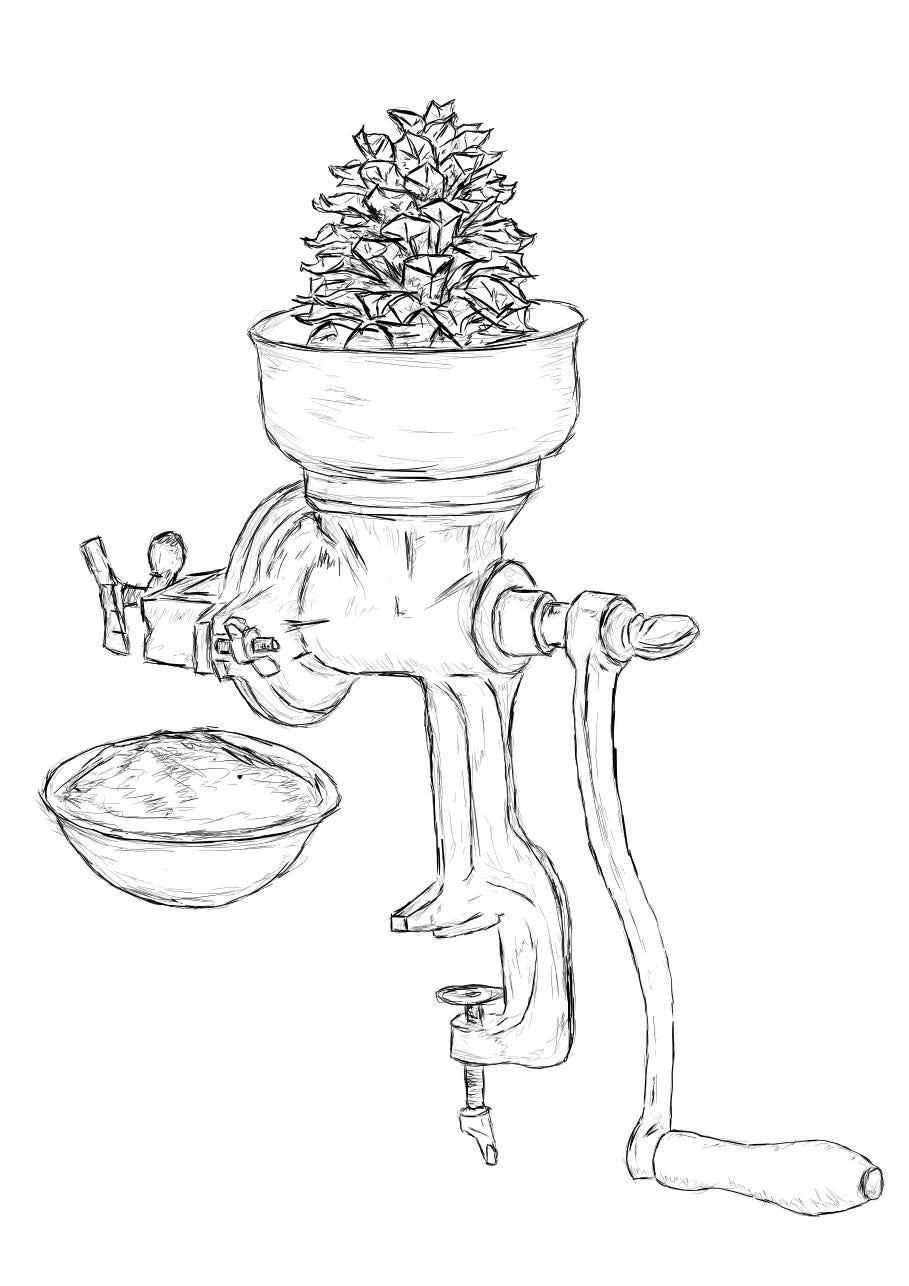
Imagine you are the father of a family and earn your living by making quality boots. Then one day you suddenly decide to build a mill for grinding pine cones into powder instead. This new product smells good and has a very interesting texture and color — but nobody needs it. First, it should be said that this doesn’t make you one inch less of a father. Second, your fatherhood will very likely soon fall into crisis. Your wife and children will have to take over as the source of income; they won’t be able to rely on your advice and sound judgment; some will condemn you, and some will still love you but visit less often.
In this article I’d like to show that this is somewhat analogous to what happened to our Reverend Fathers — though this doesn’t make our God one inch less important.
I live in a part of Europe where a book by the German author Jan Loffeld has become incredibly popular and influential. Its title is Wenn nichts fehlt, wo Gott fehlt, which translates as “When nothing is missing where God is missing.”
The core argument runs roughly like this. A long-standing assumption in theology and pastoral care held that humans are “incurably religious” — that everyone eventually asks about God or transcendence. Loffeld argues that the empirical data now undercut that assumption. What he describes isn’t atheism in the classic sense, which still defines itself in relation to God, but a deeper indifference: for many people, particularly in younger generations, no religious need or longing remains at all. People may still pursue meaning — through fulfilling work, relationships, and civic engagement — but not through religion as an overarching framework. His conclusion is that we should accept this new reality and stop blaming ourselves for causing it. He also provides empirical data showing that better pastoral services, the elimination of abuse, and similar improvements in quality don’t have a sufficient effect on reversing this course.
Jan Loffeld is not only a theologian heavily influenced by sociology, but also a Catholic priest. In a way, he is a poster child for a significant trend among Catholic clergy who have finally begun to take science seriously. The change comes late, since the Church had already largely lost its fight against rationalist modernism, relying too often on emotion and, in many cases, on false arguments, rather than on precise doctrinal thinking and effective discernment. Unfortunately, this new approach is once again a complete miss, and one that repeats itself across a wide range of fields: most recently with AI, where I saw a great deal of uncritical fascination, at least before Pope Leo XIV published his encyclical Magnifica Humanitas, which tempered the progressivist enthusiasm somewhat. Let me illustrate the point with the book itself.
Science always sees the world as it is, never as it could be. Investigating how the world ought to be lies entirely beyond its reach. Science can help you discover how to achieve what you want — and here it is powerful and magnificent — but you cannot ask it to do the very thing it gave up when it defined itself, which is to explain phenomena and respond the question of why.
When a child asks why a rainbow appears when the sun comes out after rain, you might think you’ve answered the question once you’ve told them about photons, water droplets, and how the droplets sort photons of different frequencies into different exit angles. But you haven’t described how things really are. We don’t actually know what light is. What you’ve described is physics’ current mental model — one that captures, succinctly and elegantly, everything you need to walk into a lab and recreate a rainbow.
Or, alternatively, everything you need to walk into a lab and find the edge case where the rainbow doesn’t appear, or doesn’t look the way the model predicts. Do that and you’ll be famous, at least among physicists, because you’ll have found a bug in the model. And someone else will become more famous still when they find a more elegant, more succinct model — one that fixes the bug and lets you do even more useful work in the lab and in practice. Maybe that model won’t mention photons at all.
That’s the adventure of science. It lets us repeat experiments, turn a vast body of experimental knowledge into practical tools that help people, and — best of all — build elegant, succinct mental models to keep on our tool belt. That last part is the most sublime of all, and as a software engineer I feel it keenly, because it’s exactly what we cherish too in our own field.
But there is one thing you must never do: lean on these models when you need to be airtight about how things really are. For two reasons. First, the models only ever concern practical applications and the reliable reproduction of experiments — good and evil don’t enter into them at all. Second, they are still very new against the span of human history, and they are evolving fast. It’s safe to build a computer on them. But only a fool would draw from them conclusions meant to guide humanity forever. Anyone who tries that has failed to grasp the basics of science, and I’d advise them to spend some time in a lab — or at least to build a chair with their own hands and watch how their mental models collapse on contact with reality. That usually cures the naïveté and hubris that come from trusting someone else’s experimental knowledge too much.
This is true of physics, and a thousand times truer of sociology — a fuzzy field where experiments are far harder to repeat, and thus far riskier to rely on. Imagine surveying blind people on whether they’re content not seeing colors. You’d most likely find that, while they find the idea of color intriguing, they don’t feel their lives are much impoverished by lacking the experience. It would be absurd to draw from this the value judgment that healthy eyesight is severely overrated. Yet that is exactly what priests heavily influenced by sociology tend to do. They observe what people report and take it as a more informed account of what a human being is. If, in our age, a person happened to be blind, they would refine their picture of humanity by “correcting” the role eyesight supposedly plays. With blindness, I hope the move can be seen plainly for what it is: objectively foolish, or even worse.
They could rightly use science to help return eyesight to most of society; instead, on the basis of that same science, they wrongly proclaim blindness the new standard for all humanity. You may want to object that blindness is quite different from belief in God. But it isn’t. For a Catholic priest, the sense of God is by definition as real a part of reality as matter itself; it simply cannot be an illness — an “incurable religiosity.” First, a Catholic priest cannot think like an atheist. Second, for Christ’s sake, the world is full of disoriented, suffering people trying to buy the experience of a rich life with their money, never realizing that everything money buys is fake and useless — a pale reflection of the richness of becoming a saint. Who are these priests talking to all day, I have to ask, and do they still possess basic empathy? Because I have met many people who would answer a sociological survey exactly as Jan Loffeld describes, and I have never met one I wouldn’t want to show the colors to — if only I could explain things a little better, or if these priests didn’t complicate my effort by entangling everyone in the web of thought they weave so skillfully around believers and nonbelievers alike, on the authority of their holy orders.
Dear Fathers, don’t build your pine-cone mill, however fresh that powder smells. When a priest starts playing the therapist, he makes himself useless — because he can never be a better therapist than the therapists themselves. The same goes for the psychologist, the sociologist, the scholar of religion, the motivational speaker — and yes, even the theologian. It is when you stop being mad for Christ — praying, kneeling in adoration, serving the Holy Mass, and hearing confessions — that you make yourself useless. You are not an inch less a priest, but you make yourself a useless one. I understand you don’t understand what I say while those around you clap. My point is this: the Church must shrink until people like you are gone, so that a healthier Church may be reborn.
So, for the record, it makes complete sense to me why the empirical data show that better pastoral care, the elimination of abuse, and similar gains in quality will never be enough to reverse the trend. That’s exactly what I’d expect. I love science. And that is precisely why I use it as a tool to get me from point A to point B — but never to answer why. For that, I have prayer. Such a backward guy I am.
I believe this is exactly why you say: “Oh, I’m afraid science shows that LLMs may have the same — or potentially even more harmful — effect on the spread of disinformation as social networks. Maybe we should all be nicer to each other, hug one another, and be better.” Instead of saying: “Friends, in accordance with the doctrine of the faith and with what the Holy Spirit calls us to in prayer, we proclaim that truth, and the bonds between people, are too important — like clean water and fresh air, perhaps even more so — for the infrastructure that sustains them to be left as a side project in the hands of companies whose primary business is selling advertising. No one can serve two masters.” And then you would call for science to be deployed to build that infrastructure properly.
This was just one example among many.
To put it plainly: a believer uses their sense of faith to set a task for science, instead of using science to find their sense of faith.
Dear Reverend Fathers, I feel deeply estranged from the new pine-cone scent you are promoting. Please consider closing your mill and returning to your original line of business.