

When you eat too much, it shows on your weight. When you become addicted and lose control over it, we call it the sin of gluttony. The effects are visible, and nobody can dispute them. But what about consuming things that aren’t material?
I live in a relatively wealthy country where people have figured out that there’s only so much food they can eat and still stay healthy. So they’ve started looking for other things to feed on. Individually, these pursuits are no more sinful than a sausage. Most are forms of leisure: some are sports that might even make you healthier; others are courses, workshops, concerts, lectures. The more troubling ones are where people buy a hit of adrenaline. Some of what they buy is outright immoral — sexual services, say — while some is merely draining and useless: scrolling social media, getting into flame wars there. But the absolute crown of this way of life is the vacation. Where I live, the cult of work doesn’t exist; people earn money to cover their necessities and finance their leisure. The strategy is to find every open space in your life and fill it with the best leisure you can. When people meet socially, they don’t talk about work or politics — they exchange key updates on their leisure: where they went, what they did, how it went. They call it active living, and its objective measure is a calendar filled to the last minute. A full calendar is a life well spent.
There are few Catholics where I live, but even they embrace this kind of life, or a Catholic take on it, which means they buy courses on how to be a better Christian, attend the occasional cultural event in a church, and spend their vacations by the sea with a priest leading spiritual exercises — all of it, taken individually, mostly innocent.
Catholic or not, everyone is constantly moving from one activity to the next. The ill are pitied for not being able to join in this fullness of experience, and we pray for them to recover soon, so they can catch up. Everyone seems fully engaged — everyone, that is, except the poor and me.
Me, I mostly spend my time thinking about them. Or, to be precise, about the world in general. My calendar is always partly empty, because I like it that way. I need time to concentrate and get my head around things — and that includes prayer, the kind that takes more than a couple of seconds. I also like inventing and creating all sorts of things, material and not, including these posts.
Recently I’ve started to wonder whether this lifestyle may actually wear on people. For instance: how can they recognize our Lord’s will when they have so little time to contemplate it? In my experience, that takes real effort. I can’t research this with statistics and scientific methods, so I have to allow for the possibility that everything is simply clear to them. But it can’t be clear to all of them, all the time.
Anecdotally, I meet more and more people who seem unable to describe what they’re currently living through, in almost any respect. Recently I even met a man with serious psychological troubles, which I couldn’t help attributing to an overdose of non-material consumption. He literally couldn’t finish a sentence — he kept hopping from one subject to another, unable to hold a thread. But the most telling example came in a supermarket. I asked a member of staff where to find the milk. He didn't know — "I just move these things from here to there," he said. He was neither disabled nor a foreigner, nor was there any other innocent explanation at hand; he simply had a genuinely boxed-in view of the world, completely uninterested in anything happening around him. And since then I've met him again and again, in different costumes, elsewhere.
If everything so far could be dismissed as mere coincidence, my experience of the last few years — working as a software engineer, consultant, and analyst — cannot. And it concerns all sorts of people, all over the world: they don’t read emails, they don’t read documents, even very important ones, yet they are constantly busy, hard-working people. When it gets really serious, they schedule a meeting so I can walk them through the document step by step. This has happened to me dozens of times. You could suspect I write documents that are hard to read, but it happens no matter who wrote the document. And it isn’t confined to my work. Church authorities react to articles and encyclicals they didn’t read; journalists report on press releases they know only from what someone said about them on Twitter. We can rule out that they’re all lazy or incompetent. They simply can’t do it anymore. The man I mentioned earlier — the one who couldn’t finish a sentence — was a well-educated guy. There must once have existed a previous version of him: composed, organized.
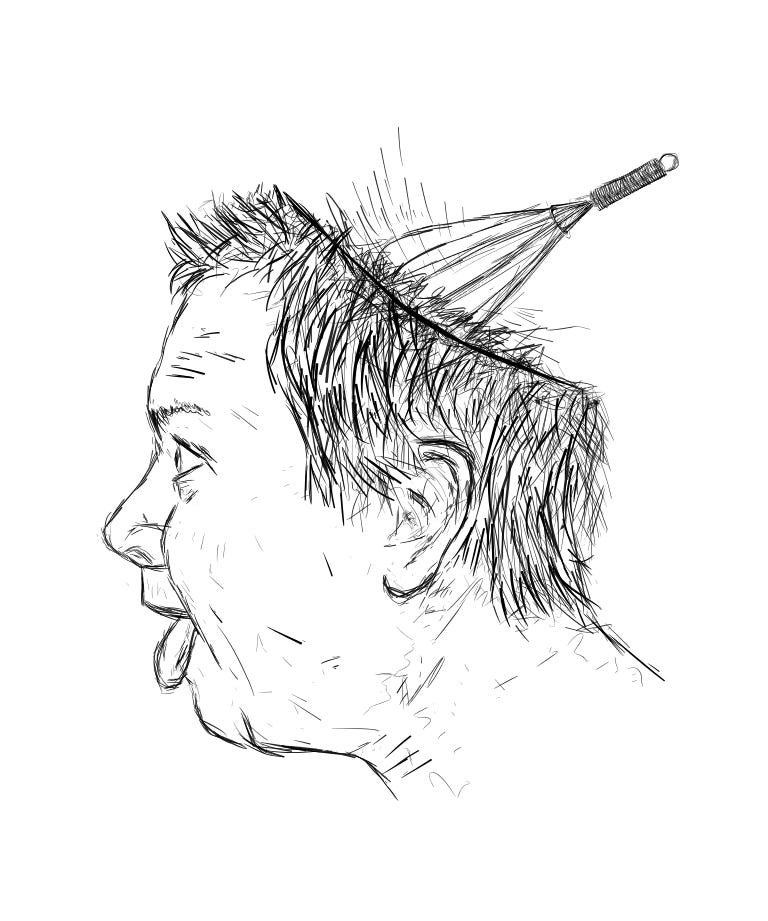
All of this led me to wonder whether there might be a kind of long-term change in the psyche — or even the brain — that comes from over-consumption of non-material things. You’d expect it to leave a mark: a non-material equivalent of obesity. I can’t imagine how exhausting it must be to consume constantly, even when nothing you consume is physical. The symptoms look a bit like sleep deprivation — I think I get into a similar state of mind after a couple of sleepless nights. It’s as if humans needed not only sleep, but also time spent alone, talking to God, digesting the happenings of their lives. Since sleep has nothing to do with this strange indisposition, at home we've simply started calling such people “whisked brains.”
I don’t use social media, so I can hardly appreciate the pressure of the fear of missing out, or how constantly comparing one’s life with others’ must push people to consume more and more of this active living. But it’s the kind of pressure that tears whole families apart. The mechanisms vary: sometimes one partner has substantially less appetite for constant consumption and fails to live the life expected of them; sometimes both partners are equally greedy, but they can’t agree on a fair split of what they call “time just for oneself.”
Occasionally, when my cover gets blown and people realize I don’t quite live the life one would expect, they get mildly aggressive. Nonbelievers usually point out that I must really have a lot of time, to be spending it the way I do. Believers reach for poor St. Thérèse of Lisieux, the Little Flower: they profess to be so exhausted by the basic necessities of their lives that they can please God only with the tiniest of things, having humbly realized they are not capable of more. Then they look at me. Pride, they remind me, is the greatest sin — and attempting anything greater than the very tiniest of things smells of pride to them.
Having analyzed all of this and considered things meticulously, I dare to conclude with a couple of recommendations.
The first would be to statisticians and sociologists. To them I’d suggest a new metric, something to measure and keep an eye on over the years to come: the percentage of documents and similar resources a person encounters, over a given period, for which they can correctly ascertain why the thing was written — the motivation behind it. The metric would cleverly pack two things into one number: functional understanding and empathy. It would tell us whether people are still able to carry out their duties more than mechanically, and whether they can still grasp what moves other people. I hope it would become a reliable source of good news, since from its current value, I believe, it can only go up.
And to all my neighbors living the active life, I would dare to suggest: please, consider at least entertaining the possibility of freeing, say, 20% of your calendar, and spend the time with boredom. Lose that time with God. He will forgive it, in my opinion, and may even use the space for something unexpected. Maybe someone will manage to reach you — not a beggar or a homeless person to whom you throw a dime, but perhaps someone you might join in some purposeful effort, something that would make sense to you both and please God, even if it is not the very tiniest of things.
St. Thérèse of Lisieux, I know how you meant it when you wrote in your diary about God, the beggar of love. Please, pray for us.