

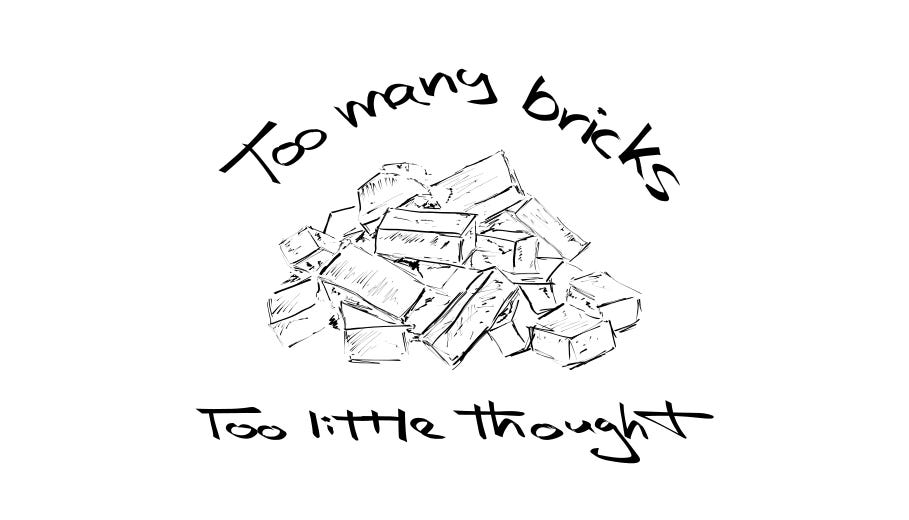
That sentence may sound strange, but I mean it quite literally.
Consider how expensive it is to build a new cathedral. Now imagine giving that same sum to a team of dedicated people tasked with creating a new, effective representation of the catechism — perhaps not a book, but something more effective — capable of capturing more detail without requiring more pages or compressing meaning behind terms that are hard to grasp. I mean something that doesn’t alter the doctrine in the slightest; on the contrary, it presents everything in a detailed, accurate, and understandable way, using the terms, language, and modes of expression natural to this century. Something that would bring people to an understanding they wouldn’t merely deem plausible, but one they could genuinely accept, internalize, make peace with, and align their lives around. Something they could discuss publicly without embarrassment and pass on to others — who would, in turn, also find it plausible. Some of those people might accept it; others might forcefully reject the Lord Jesus, recognizing how uncomfortable and dangerous His path would be for their ambitions, wealth, and social standing — recognizing Him as “a stone that causes people to stumble” (1 Peter 2:8).
You may find it strange to speak this way about spreading Christianity. It may even seem wholly impossible, since today most people reject the faith for entirely different reasons. They reject it because, once you look beneath the surface message that we should all be kind to one another, the deeper explanation begins to sound like strange syllogisms — a curious play with language and logic, detached from the hands-on approach we’ve come to expect from the sciences, and therefore, on the whole, illegitimate.
Yet there were times when Christianity spread in precisely the manner I described above. Which means it is possible — or at least that it once was.
From here, the discussion tends to branch. One side argues that the old way of teaching is no longer possible, given what we now know and how far humanity has progressed. The other replies that there is no problem with the effectiveness of syllogisms if one tries hard enough to comprehend them — that anyone willing to study Aristotle and Aquinas can recover the mode of thought that was once ubiquitous. A third position cuts the knot differently: it makes no sense, this view holds, to dig any deeper than the message of interpersonal kindness, which can stand on its own. If doctrine contradicts that message, doctrine should be rewired to suit the times.
I don’t side with any of these branches. Yet I’m almost certain that all parties to this discussion, after careful investigation, would unite around one objective truth: we simply haven’t tried hard enough to reformat the way the teaching is taught. That effort could prove immensely difficult and expensive — yet still feasible, compared to rewiring the doctrine itself (especially if the doctrine proves as unyielding as the laws of physics). And we cannot simply sweep aside the testimony of those experts in syllogisms, who warn us that rewiring the doctrine would force us to accept a life lived in a lie. That is something we cannot accept — not in science, not in religion, not in any other field of human endeavor.
As someone who has already invested significant effort into finding new ways the doctrine can be expressed in a plausible and acceptable form, I can testify that it seems quite feasible — or at least, far from a lost cause.
The real reason we haven’t tried, I suspect, lies in the bricks. Imagine the moral hazard of paying a cathedral’s worth of money to people for an intellectual effort like this — one that many doubt can even succeed. What if they failed? Who would be held accountable when a cathedral’s worth of money is gone, with nothing left to show for it — not even a single brick? We are taught how important it is to be practical, to focus on everyday things; and somehow an intellectual effort to anchor the fundamentals for this age seems suspicious, while investing substantial resources in it could even spark outrage. This stands in stark contrast with the Middle Ages, when people concentrated primarily on how to attain salvation — for which technical progress may have suffered during that period.
In the current age, we have the opposite problem. We have refrigerators, yet we have lost the meaning of life. It is largely for this reason, I think, that some say today that Christ in the Eucharist can dwell in a modest space without being surrounded by expensive works of art. A single cathedral’s worth of money, they argue, could instead be converted into one modest but lofty church and three community centers — with plenty left over to feed the poor. But the lofty church will always stand half empty, the community centers will be rented out for yoga lessons, and the poor will learn that we do not take the Real Presence of God quite seriously — a posture they themselves will tend to adopt, since we have modeled it as normal.
Now take a step back and imagine what would happen if that great intellectual effort were more acceptable than piling bricks. Imagine if that group of people, to whom you gave a cathedral’s worth of money to build a new form of the catechism, actually succeeded.
Mightn’t that help feed the poor on an entirely different scale? Wouldn’t it make possible many lofty cathedrals where Christ in the Eucharist could dwell, surrounded by works of art more awe-inspiring than any seen before — each cathedral with ten community centers within commuting distance?
I know many Christians may hate to hear this suspected triumphalism, at a time when we are being encouraged to accept that there will be fewer and fewer of us, and to cherish that very diminishment. But what if the diminishment is simply because we have never really tried? It seems to be an objective fact that for the past two centuries we have not invested significant resources into investigating how the teaching might be taught effectively — with a measurable impact on whether its recipients were able to either accept or reject the Lord Jesus in an informed way.
You may have heard that more Christians face persecution today than ever before — but it is not because the evil regimes of the world have correctly ascertained the power of the Gospel. What these regimes are truly against is human rights, and religious freedom in particular. If those same Christians were instead adamant about practicing a particular form of yoga in a suspiciously spiritual way, they would be persecuted, tortured, and killed just the same.
Persecution is not evidence that the Gospel is being heard. It is evidence that freedom is being denied. The work of being heard still lies ahead of us, and we have barely begun it.