

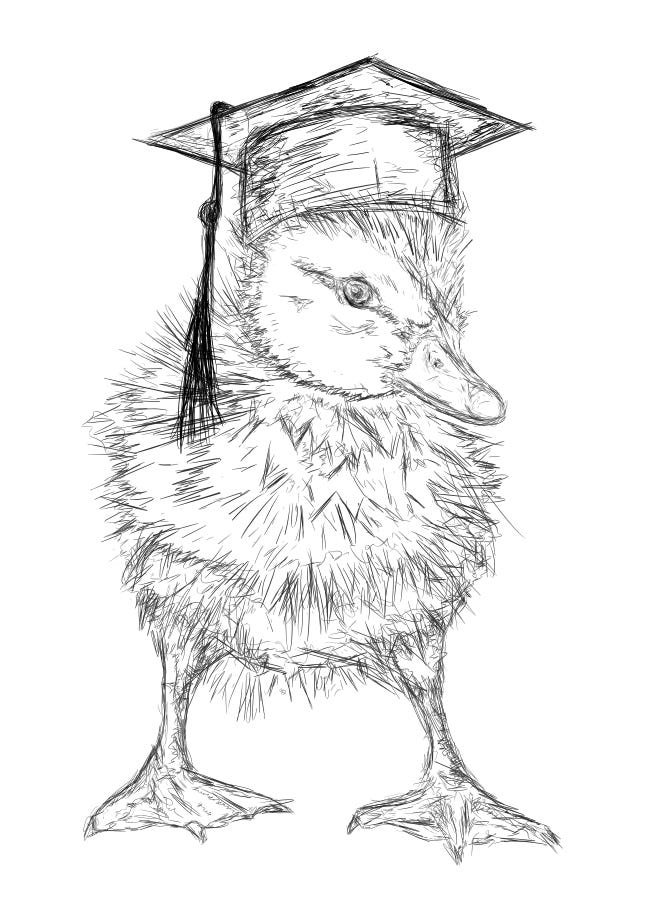
In medieval universities, the faculty of theology held the highest rank. It was often called regina scientiarum — the queen of the sciences. Theology was seen as governing the other disciplines, orienting all human knowledge toward its ultimate end: salvation, union with God. The other sciences were treated as merely auxiliary tools.
It makes sense to have a whole field devoted to the rigorous study of what to do with one’s life. It’s like acknowledging that what makes a good writer is knowing what to write about: fluency with the tools is a necessary condition, but not a sufficient one. And each of us is, to some extent, the writer of our own life, so having a basic orientation toward what makes a good one seems important enough to take seriously. Even in today’s secular world, there’s a large market for self-help books and similar material aimed at exactly this, so it’s hard to argue the field no longer matters.
It can’t be said that the self-help shelf is the queen of the bookstore, but that’s understandable, since today’s worldviews look less like a single coherent system than a sprawling, fragmented chaos. What puzzles me far more is that no one would go to the self-help shelf — or any nearby shelf — to browse books on theology. It’s not that readers dislike theology; it’s that these books simply aren’t there. Theology is now perceived as an academic discipline, a field for experts. There are certainly theologians who write for ordinary people, but standing in front of a room of academic theologians and proclaiming that they are, in essence, meant to be the authors of “Life for Dummies” tutorials would likely provoke ridicule and backlash.
Oh no — they don’t write for dummies. They develop original ideas in their respective niches, then publish articles in journals, just like other scientists. You can certainly read those articles, often even without a PhD, but you need to be familiar with the background — and, most of all, you need a university login.
The problem is that theology may have been called regina scientiarum, but it certainly can’t be considered an experimental science. Its source of knowledge is divine revelation, which is taken to be, in some sense, complete. So it’s hard to discover anything new, and twice as hard to verify what you do find. To develop revealed knowledge you have to rely on razor-sharp logic, just as in philosophy — though that logic is necessarily far less sharp than what we apply in mathematics, since the medium here isn’t formalized, it’s natural language. But if you’re willing to accept a degree of imprecision, or to rule it out by properly defining what truth means to you, you can proceed much as you would in philosophy. You can study what your predecessors wrote, develop their ideas a little further, go into finer detail, cover the edge cases. Why not? This kind of scholarly work has an aesthetic to it, and I’ll admit that to me it could even feel like a marvelous form of leisure.
Of course, what you lose is any universal claim, any authority. This isn’t how our society treats things that need to be relied on in a rock-solid fashion — the way we rely on bridges to hold people up, or on aircraft to carry them safely through the air. When lives are at stake, the standards are so much higher that the two hardly compare. The weight of responsibility an engineer bears is on an altogether different scale from that of an academic theologian — no leisure in it. And indeed, these have always been two different scales: one running between life and death, the other between salvation and damnation. Needless to say, as a practicing Catholic, I consider one of them infinitely more important than the other.
There is something rotten in the state of theology.
If you raise a duckling as a foster parent, it will consider you its mother and follow you wherever you go. I believe this is precisely what happened to theologians when the reign of experimental science took hold across the universities. They simply follow whatever the other academics do, to stay with the herd. You have to come up with original ideas, invent new things, keep pace with your peers. So the scientists do research in their labs, and the theologians study in their studies. Both produce papers — expert-level, detailed documents you won’t understand as a mere mortal, unless you spend some time getting up to speed in the field. With experimental science, that’s not a problem. Skilled engineers will do it for you, and from the new findings they’ll design a better fridge or a faster processor. You don’t need to understand circuit boards to write a document on a computer, and you can use a fridge without knowing anything about its cooling mechanism. Knowing nothing at all can get you into trouble — but you certainly don’t have to track the latest discoveries as they optimize the technology in subtle ways.
With theology it’s different. You can’t hire an expert to rewire your soul for you. You are the sole engineer of your own salvation. But that’s fine — since the revealed truth doesn’t change, and since most of us, if not all, are unable to implement even the basics in our lives, it makes no sense to consume academic papers on the nuances in the thought of some thinker you’d never heard of anyway. This is why even practicing Catholics like me — and, I suspect, most priests and bishops too — don’t much care what’s happening in academic theology today. It’s hard to imagine how it could have any bearing on the salvation of my soul, or of anyone else’s. I wouldn’t go so far as to call academic theology completely useless — many fields of inquiry saw no practical use for a long time, until suddenly they did — but it’s fair to say I don’t expect it to make any difference in my life, in my children’s lives, or in the lives of those close to me.
So, to reiterate: we have problems with the basics. In fact, most of Western society does. For a large part of it the problems have grown so significant that people have lost faith in revealed truths altogether — the claims now strike them as simply implausible. Those are the ones who browse the self-help shelves instead.
Meanwhile, priests and bishops recite the same sentences they always have to their ever-narrowing flock; the flock nods, says everything is perfectly fine, and next year there are fewer of them again — yet the feedback is exactly the same every time. They want to hear it in the way they already understand it: the exact same words, the same sentences, doctrinally safe yet less and less comprehensible from outside the church. And I can attest that they’re less comprehensible from within it too. It’s my firsthand experience that many clergymen will refuse to confirm the accuracy of the same truth formulated in a different way. They play it safe with safe wording, because they too are no longer certain they possess an accurate, working grasp of the doctrine. This is why I admire Joseph Ratzinger, who always could.
It’s really fascinating. One would expect a huge research effort to be under way, trying to work out — through analysis and experiment — why people are losing faith, why they resist the Gospel; because it’s absolutely certain that the Gospel is not to blame, only the way it’s proclaimed. One would expect many alternative approaches to be tested: how to talk about faith effectively, how to address people’s doubts, how to reconcile them with the findings of experimental science. After all, the revealed truth is complete and unchanging — and it isn’t even immensely extensive. And since the Gospel was meant by God to be proclaimed to all, not only to thoughtful intellectuals, there must be a way to formulate the same eternal truths as effectively and accurately in this age as in ages past.
So where are all the competing ways of explaining the very basics of Catholic doctrine to ordinary people? I hesitate even to call it theology, since theology, as I’ve pictured it, is quite a different endeavor. For practical purposes, let’s call it RS — for regina scientiarum. Pronounce it “rēs.”
Ever since I converted, around the age of fifteen, I’ve been passionate about rēs. In the years since, I’ve tried to formulate various doctrinal truths precisely and accurately, in a way compatible with the scientific view. I remember once, still a teenager, visiting a renowned, high-ranking academic who happened to live in the same building where my grandparents had a flat, and trying to demonstrate to him how I would explain a particular point. I can still remember his reaction. He didn’t understand my motivation at all, and said something to this effect: “My dear colleague, I’m afraid you’re trying to break down a door that’s already open — I’m sure several of my fellow academics have published similar ideas in some journal by now.” I couldn’t get across that I wasn’t struggling to claim a novel idea, but to help ordinary people reach a working understanding of the doctrine. For him, my rēs had no place among the coined terms.
During the Middle Ages it was quite normal to discuss doctrinal questions in a pub. There are historical records of authorities complaining that people did exactly that. Our ancestors had a working understanding of the doctrine — in other words, they knew quite well what they believed and why. We are in a very different situation.
Catholic dogmas seem so distant, detached, and incomprehensible to us that we hesitate to discuss them in public. We understand almost every aspect of how the world works far better than our medieval ancestors did, yet we don’t understand what we believe. We can boast several gadgets in each hand that would have seemed like magic a few hundred years ago — the jewels of the kings of the world. We are kings, and yet the crown is somehow fundamentally missing. In my experience, instead of serenity, many believers feel a quiet fear of losing their faith when they delve into the very basics we recite in the Creed every week. When they can’t root their faith in a working understanding of the doctrine, they root it in their way of life instead — which we call tribalism. Or they take their inner peace from a guru — which we call clericalism. But most often their faith has simply been washed out into a kind of leveled-down humanism: the lowest common denominator of all denominations and beliefs.
We need to develop a functional rēs. Maybe you can rid yourself of the bad things you do simply by deciding you believe they’re bad. I have to admit that I always needed to understand why they were bad — only then could I stop doing them. In my view, cultural Christianity can only become a reality when we stop being ducklings and start arguing about dogmas in the pub again.