

To me, economics is a genuine mystery. I’ve tried many times to understand it, even just its basic principles, but I grasp its rules about as well as a tone-deaf person carries a tune. And yet I find it as fascinating as many tone-deaf people find music.
As I understand it, the economy began the first time two people were willing to trade, each owning something the other wanted. That in itself is a small miracle. For it to happen, both sides had to trust that they wouldn’t be cheated or robbed, or at least that if they were, they wouldn’t lose more than they could afford.
I’ve never quite managed that kind of trust myself. Sure, I’m not afraid in that sense when I go to the supermarket. But that’s only because I know the people selling the goods there own neither the shop nor the goods, and are too powerless to do me any real harm. That’s why I buy my food at the supermarket instead of growing it in my garden. I should add, though, that I live in one of the safest countries in the world, one that’s fairly rich and well run. I’ll never understand how any of this could have worked a few hundred years ago, except perhaps among very wealthy relatives.
Over the course of my life, I would have bought many more things, especially services, from many more people if I hadn’t been afraid they’d take advantage of me. Instead, I learned to live without a lot of things I could have used, and built some of them myself. That cost me a great deal of time I could have spent on things that truly matter, which is a bit like saying I could have spent it serving God.
Yes, even in economics, it seems you only have to turn the first corner to run into questions of faith and God. How hard it is to live a life of purpose seems to depend directly on how safely we can rely on other people and how well integrated we are as a society, or, conversely, how much we have to live like isolated islands. At the very beginning of the Bible, Adam wanted to assert his independence and take control, and he was remarkably successful at defying God’s vision of communion.
Have we really become so much better at trusting each other over the centuries? If we have, I’ve fallen terribly behind. I’ve found myself trusting people less and less the better I’ve come to understand them. I can’t quite grasp how society has functioned for so long without falling apart. I often ask myself: is God constantly tampering with everything around me, on a grand scale? Is it a miracle? If not, where did all this trust come from, and is it really there at all? The trust that apparently holds society together, but that I can’t see, is one side of the mystery of the economy.
So for me, being able to use money every day is a bit like walking on water. I should have sunk long ago, yet I can still go out and buy things. But there’s another side to this mystery: that I have any resources to spend at all. In other words, how come people have been willing to pay me for what I do? It’s not that people have reason to be wary of dealing with me; I think many people around me can tell that I take my faith in God seriously. Nor do I lack rare skills. I’ve been gifted with quite a few, and I can put them to good use. What I don’t understand is why some of them, the ones I actually consider less important, are still in demand, while some of my most essential skills, without which I’d find life wholly unbearable, seem to be of no use to anyone except perhaps my closest family. I seem to be surviving by accident, or by a miracle. I’m like a baker who makes his living renting out a few rooms in his house, rooms that stay warm thanks to the oven in which he still bakes bread for his family’s table — bread nobody buys anymore. Perhaps it’s a lack of trust in God, which happens to be one of my weaknesses, that makes me fear a day may come when none of the skills I can offer will be in demand, and people will get along just fine in the cold.
This fear doesn’t seem unrealistic or irrational to me, since the reverse also seems to be true: much of what society has to offer is of no use to me. Let me give a couple of concrete examples.
I have no use for a better car, for instance. The features on offer usually don’t interest me at all. I don’t need heated seats or more comfortable upholstery. On the other hand, my car lacks many practical features that no one offers. I’d gladly pay extra for a washer fluid level sensor, an open-window warning, a battery charge indicator, and other detailed alerts about what might soon need servicing. I can even put up with a fair amount of discomfort if that’s the price of freeing up time for things that truly matter instead of chasing down car problems that should never arise in the first place. In the same way, I don’t need a better smartphone with a better built-in camera, because I rarely take photos, and when I do, I need far better optics than any smartphone can offer. Taking casual snapshots would only eat into my time instead of freeing it up. Meanwhile, I’m still waiting for some practical smartphone features that were rumored before the iPhone 5 came out but never materialized, and that could have helped me free up a bit more time for God. Sorry to go into such detail; I just want to make it clear that these are real, practical needs, not superficial, sanctimonious objections.
By the same token, I would never buy a larger house, because I don’t want to spend even more of my time maintaining it, yet I’d gladly pay extra for a house that needed even less of my time than mine does now. I also have no desire to travel the world just for the experience, yet I’d gladly move to the other side of it if the skills I consider most important were in demand there. In general, I’m willing to pay exactly zero for anything offered to fill my free time, usually under the label of fun. There are few things I find more boring than having fun, especially the paid kind. Killing time feels to me like a partial murder, and if it’s quality time, then it’s a quality murder.
At the same time, I long for many things I’d gladly spend my time on, things that don’t exist yet. There are many unwritten books on subjects I find important that I’d eagerly read, films I’d watch with delight, music, both classical and popular, that no one has composed yet, paintings no one has painted, even sculptures. It extends even to basic household items. For years, we haven’t been able to find a crucifix with a figure of our Lord that we’d be happy to hang in our home. We still don’t have one, and I’ll probably have to make one myself.
I even struggle to buy basic, decent-looking clothes. I find it hard to believe that aesthetics don’t matter to God, the same God who devoted several entire chapters of Exodus to meticulously describing the fabrics of the tabernacle and the garments of the priests. Quality clothing also saves time, since it lasts longer. So I can’t accept that what we wear is unimportant, or that it lies outside our proper relationship with God. That’s also why I would never buy clothing with any visible mark on it (unless the manufacturer paid me properly for renting out my body as a billboard for their logo). The only alternatives seem to be cheap, low-quality products or expensive tailor-made clothing, which makes sense for state officials, concert virtuosos, or clergy, but not for ordinary programmers like me.
To sum it all up, there seems to be a huge disconnect in my case between supply and demand: between what I need, what I want, what I’m willing to work for and pay for, and what society can provide. Isn’t that supposed to be the central principle around which everything in economics revolves, that demand drives supply? So am I just an exception? Is it some law of nature that most people need completely different things than I do? Why do I happen to be the outlier while they happen to be the majority? Is something wrong with my mind? Or with theirs? Can anyone explain this to me?
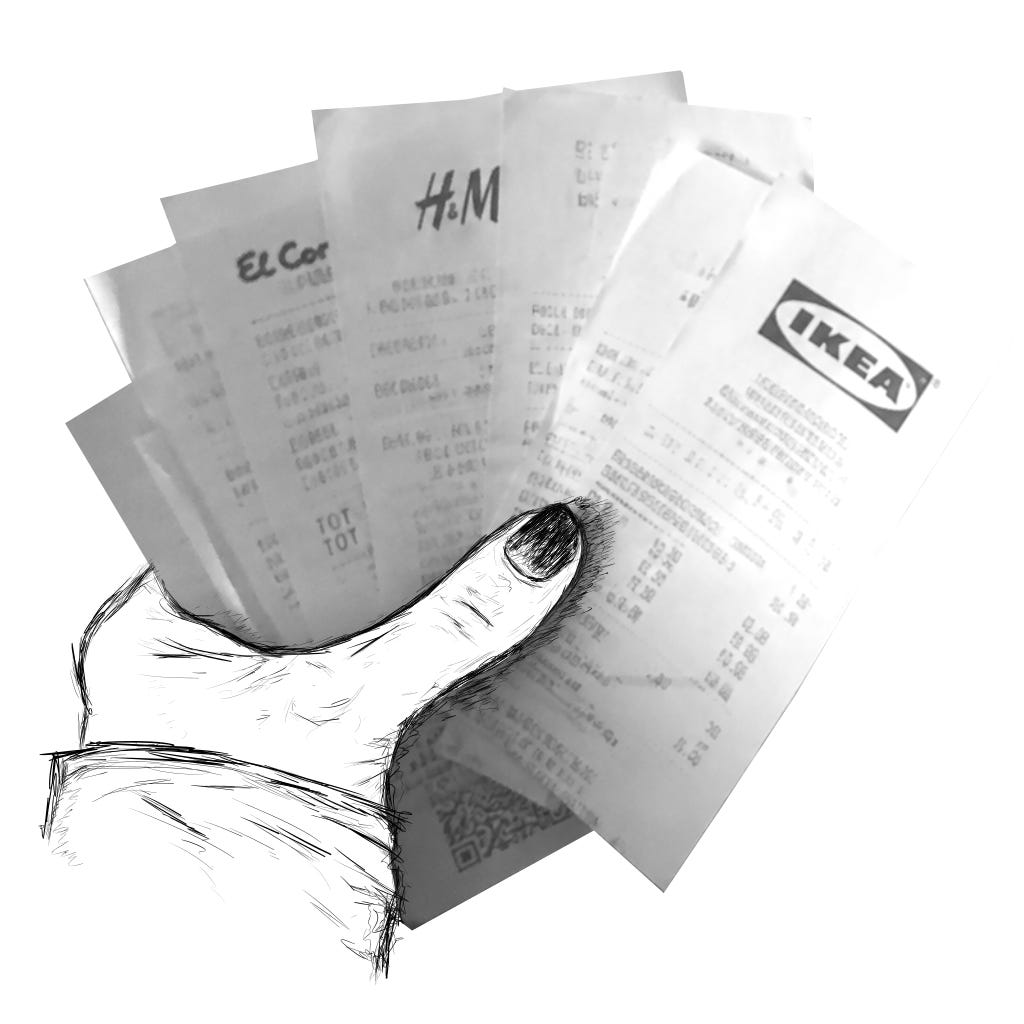
There is a lot of talk about how our planet is going down the drain because of excessive consumption, resource depletion, and environmental damage. We keep hearing appeals to conscience, while people go on making small talk, comparing what they’ve spent on this and that. When I hear these conversations, my mind drifts off so completely that some people consider me deeply introverted. I sometimes wonder why they don’t just lay their bills on the table in silence, the way we do when we play cards.
This has been going on for decades, yet the appeals have achieved very little. It seems as if economists, sociologists, and psychologists all agree that this is simply what people need, as if by some law of necessity. Many argue that the only real option left is legislation that curbs consumption directly; otherwise, we will spend our children’s future and leave them a debt of unbearable living conditions.
Yet the truth is, I don’t need to spend more, I don’t want to spend more, and neither does my family. In fact, if some of our demand were met, we could even spend less. If we were in the majority, whole industries would be working on how to free up people’s time so they could spend it on things that truly matter. Maybe this could even fuel economic growth for decades, enabling all of us to spend less and less. And then, once everything ran like a well-oiled machine, I could spend days on pilgrimages and in processions, enjoying feasts and liturgies celebrated near the tabernacle, praising God, talking with people, and simply being with them.
I could keep doing this for all eternity: a pleasure I’d never tire of, and one that would cost only a modest, appropriate amount of natural resources.
I want it, I need it, I demand it. And I really don’t get it.